China Visa-Free Transit in 2026: The 240-Hour Rule for US, UK, CA, and AU Visitors
How China's 240-hour (10-day) visa-free transit policy works in 2026, who qualifies, which ports and regions you can use, and when you still need a tourist visa.
Last updated
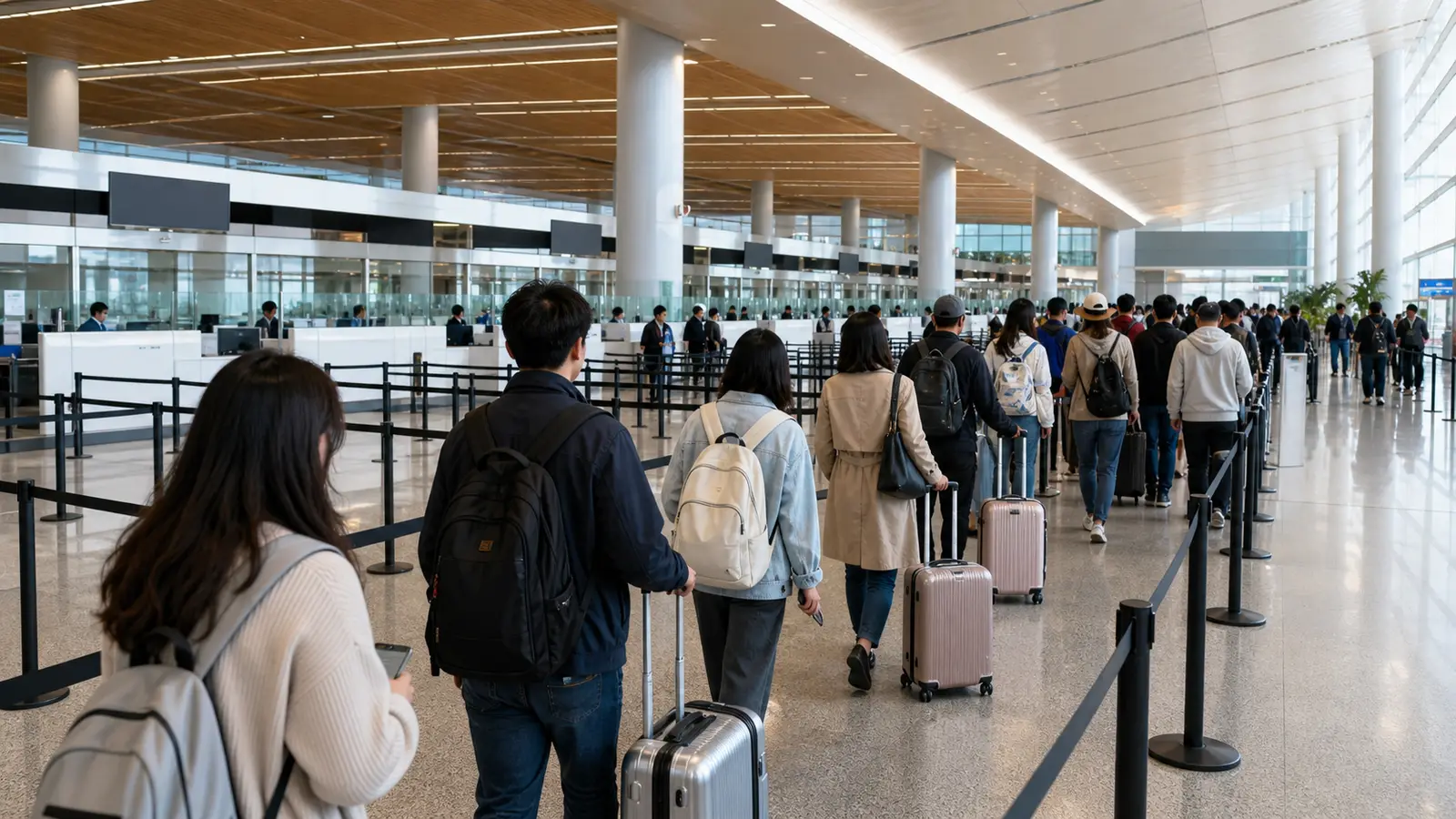
If your trip routes onward to a third country or region rather than straight back home, you may not need a visa at all (onward legs by air, rail, or cruise can qualify). China’s 240-hour visa-free transit policy lets eligible travelers stay up to 10 days for tourism, business, or visiting family. It is the simplest legal way into China for many first-time visitors, but it comes with conditions that are easy to get wrong. Always confirm the current rules with the National Immigration Administration before you book.
Are you eligible? The 5-point checklist
You qualify for 240-hour visa-free transit only if every one of these is true:
- Ordinary passport from one of the 55 eligible nationalities (US, UK, Canada, Australia, and others below).
- At least 3 months of passport validity on the day you arrive.
- A confirmed onward ticket to a third country or region, with a fixed date and seat, departing within 240 hours. By air, rail, or cruise. A round trip back to where you flew from does not count.
- You enter and exit through one of the 65 designated ports.
- You stay only within the 24 eligible provincial regions. Tibet, Xinjiang, Inner Mongolia, Qinghai, Gansu, Ningxia, and Jilin are not covered.
Miss any one of these and you need a full tourist visa instead. The details below explain each rule.
What the 240-hour policy is
The 240-hour rule lets qualifying foreign nationals transit through mainland China for up to 10 days without applying for a visa, as long as they are traveling onward to a third country or region. It replaced the older 72-hour and 144-hour transit schemes and was extended to 55 nationalities. The clock is generous: your 240 hours start at 00:00 on the day after you arrive, not at the moment you land. Arrive at 1pm on a Monday and the count begins at midnight, giving you a full 10 days on top of arrival day.
Who qualifies
Citizens of 55 countries are eligible. That includes the United States, the United Kingdom, Canada, and Australia, along with all Schengen countries, Ireland, New Zealand, Japan, South Korea, and others. You need an ordinary passport with at least three months of validity and confirmed onward travel. Note that ordinary tourist visits using transit are limited to leisure, business, and family activities. Work, study, and journalism are not permitted on visa-free transit.
The onward-ticket condition
This is the rule that trips people up. You must hold a confirmed ticket, with a set date and seat, to a third country or region. That means you cannot fly in from the US and back to the US. A round trip to the same country does not count as transit. A genuine example: New York to Beijing, then Beijing to Seoul (or Tokyo, Bangkok, or any other country) within 10 days. Hong Kong, Macao, and Taiwan count as separate regions for transit purposes, so a Shanghai-to-Hong Kong onward leg can qualify.
Where you can enter and stay
Entry must be through one of 65 designated ports across 24 provinces, autonomous regions, and municipalities. Major gateways include Beijing, Shanghai, Guangzhou, Chengdu, Xi’an, and many others. Under the current policy you may move freely across all 24 eligible regions during your stay, so a Beijing-Xian-Shanghai loop is allowed because all three sit in the covered area. A practical 2-week China itinerary built around those cities fits comfortably inside both the 24 regions and the 10-day clock if you keep the route tight.
Seven regions stay outside the policy and are off-limits on transit: Tibet, Xinjiang, Inner Mongolia, Qinghai, Gansu, Ningxia, and Jilin. If your trip must include any of these, you need a full tourist visa instead. The covered area keeps expanding (it grew from 19 to 24 regions in late 2025), so check the current list before you finalize a route near the edges.
Transit versus a full tourist visa
Visa-free transit is ideal if 10 days is enough and your itinerary naturally passes through a third country. It saves the visa fee, the application, and the wait. The trade-offs: you are capped at 10 days, you must keep that onward ticket, and you are confined to eligible regions. If you want longer than 10 days, a true round trip from home, or destinations like Tibet, apply for an L tourist visa instead. A standard 10-year US visa or a single-entry visa removes the onward-ticket headache entirely and is often the calmer choice for a first multi-city trip.
Once your entry is sorted, set up the basics
Visa-free transit gets you through immigration. To actually function inside China, line up two things before you land. Get a China eSIM that works without a VPN so Google Maps, WhatsApp, and Gmail keep working from the airport, and set up Alipay as a foreigner so you can pay at shops, taxis, and restaurants that no longer take cash or foreign cards. Both take five minutes and are far easier to arrange at home than on arrival.
Because ports, eligible regions, and conditions change, verify the latest details with the National Immigration Administration and your airline before you travel.
Frequently asked questions
- Which countries qualify for China's 240-hour visa-free transit?
- As of 2026 the 240-hour (10-day) visa-free transit policy covers citizens of 55 countries, including the United States, United Kingdom, Canada, Australia, New Zealand, and most of Europe. You must hold an ordinary passport valid for at least three months and enter at one of the more than 65 eligible ports. Always confirm your current eligibility with the National Immigration Administration before you rely on it.
- What are the conditions for using China's 240-hour visa-free transit?
- You must be transiting to a third country or region, meaning you arrive from one country and hold a confirmed onward ticket with a set date and seat to a different third country, not back to where you came from. You then have up to 240 hours and must stay within the designated provinces, which include Beijing, Shanghai, Xian, and Chengdu. The clock starts at midnight after your arrival day, and you must enter and exit at eligible ports.
- Where can I travel under China's visa-free transit, and where can't I?
- The 240-hour policy lets you move freely within 24 participating provinces and municipalities, which cover the main first-timer route of Beijing, Xian, Shanghai, and Chengdu. It does not cover regions like Tibet, Xinjiang, Inner Mongolia, Qinghai, and Gansu, so you cannot use it for those destinations. If your trip needs those areas or more than 10 days, apply for a regular tourist visa instead.