China Itinerary: Routes and Days for a First Trip
Plan your China itinerary: how many days you need (10 to 14 is the sweet spot) and three first-timer routes through Beijing, Xi'an, Chengdu, and Shanghai.
Last updated

Most first trips to China come down to two questions: how many days you need, and which cities to string together. A good first-timer china itinerary runs 10 to 14 days through Beijing, Xi’an, and Shanghai, the route nearly everyone starts with. This hub helps you choose the right length and variant, then points to a full day-by-day plan for each. Three routes cover almost every first trip.
Choose your route
Pick the variant that matches your time and pace. Each links to a full day-by-day plan.
| Route | Length | Cities | Best for |
|---|---|---|---|
| Classic 10 days in China | 10 days | Beijing, Xi’an, Shanghai | The standard first loop: headline sights, two short train hops, no filler. |
| 2 weeks in China | 14 days | Adds Chengdu pandas and Guilin scenery | More time, two extra stops, a fuller picture of the country. |
| First-time China itinerary | 8 to 10 days | Beijing, Xi’an, Shanghai (relaxed) | The gentlest version: same big three, slower pace, fewer decisions. |
If you are unsure, start with the classic 10-day route. It is the one most first-timers fly home happy with.
How many days do you need in China?
For a first visit, 10 to 14 days is the sweet spot. That is enough to see Beijing properly, add the Terracotta Army in Xi’an, and finish in Shanghai without living on trains. Pick by the time you have:
| You have | Do this | Plan |
|---|---|---|
| One week | Beijing plus one other city. Move fast, see the headliners. | Trim the first-time route to 7 days |
| 8 to 10 days | Beijing, Xi’an, Shanghai at a relaxed pace. | First-time China itinerary |
| 10 days | Beijing, Xi’an, Shanghai, the classic first loop. | 10 days in China |
| Two weeks | Add Chengdu for pandas or Guilin for the Li River. | 2 weeks in China |
The classic seven-day skeleton below shows the shape every version builds on.
When should you go to China?
Aim for spring (April to May) or autumn (September to October), the sweet spot for mild weather and clear skies across Beijing, Xi’an, and Shanghai. Summer is hot and humid with afternoon crowds; winter is cold in the north but quiet and cheaper.
Avoid two national holidays when prices spike and every sight is packed:
- National Day Golden Week, October 1 to 7. The single busiest travel week of the year. If you visit in October, start after the 7th.
- Chinese New Year, around February 17 in 2026 (holiday February 15 to 23). Trains and flights sell out as the whole country travels home.
How do you get between the cities?
High-speed rail links the main cities and is faster and easier than flying for these distances. Headline durations on the fastest trains:
- Beijing to Xi’an: about 4 hours 20 minutes to 6 hours.
- Beijing to Shanghai: about 4 hours 18 minutes to 6 hours.
- Xi’an to Shanghai: roughly 6 to 8 hours.
You book most routes with your passport using real-name ticketing. See how to buy train tickets in China for the step-by-step, including which app to use and when tickets release.
Do these bookings first
Two sights sell out and have no walk-up tickets, so handle them before you fix the rest of your plan:
- Forbidden City in Beijing. Tickets release online only, 7 days ahead at 20:00 Beijing time, and go fast. Read how to book Forbidden City tickets for the exact steps.
- Terracotta Army in Xi’an. Daily entry is capped, so reserve online up to a week out.
Both use real-name booking: you enter your passport number when you buy and scan the same passport at the gate.
Set up before you fly
Sort the practical layer that trips up most first-timers, ideally before you leave home:
- A travel eSIM for China so maps, translation, and messaging work the moment you land.
- Mobile payments. Alipay and WeChat Pay run daily life far more than cash or cards.
- Your visa or visa-free entry. Many US, UK, Canadian, and Australian visitors qualify for the 240-hour visa-free transit, now open to 55 countries. Confirm the rules fit your passport and route before booking flights.
Pick a city below to see what to do there, or jump straight to the route that matches your trip length.
- Day 1
Arrive in Beijing Beijing
Land, set up your eSIM and mobile payments, and keep it light with an evening walk around Qianmen to beat jet lag.
- Day 2
Forbidden City and Tiananmen Square Beijing
Forbidden City (Palace Museum)
The trip's must-book sight. Reserve online 7 days ahead, since there are no walk-up tickets.
- Day 3
Great Wall at Mutianyu Beijing
Great Wall at Mutianyu
A half-day trip to the best-restored Wall near Beijing. Cable car up, toboggan down.
- Day 4
Temple of Heaven and Summer Palace Beijing
Temple of Heaven, Summer Palace
A calmer day of imperial parks before you move on by train.
- Day 5
High-speed train to Xi'an Xi'an
Getting there: HSR · 4h 10m to 6h 45m
About 4 hours 20 minutes to 6 hours, booked with your passport. Dinner in the lit-up Muslim Quarter.
- Day 6
Terracotta Army and the city wall Xi'an
Terracotta Army (Emperor Qinshihuang's Mausoleum Site Museum), Xi'an City Wall
Reserve the warriors online up to 7 days ahead, then cycle the old city wall toward sunset.
- Day 7
Train to Shanghai, evening on the Bund Shanghai
The Bund
Walk the Bund once the Pudong towers light up. From here you can fly home or, with two weeks, add Chengdu or Guilin first.
Where first-timers go

Beijing
China's capital packs the country's biggest landmarks into one city, making it the natural first stop for a first-time visitor. You can see imperial palaces, ancient temples, and the Great Wall all from a single base.
Xi'an
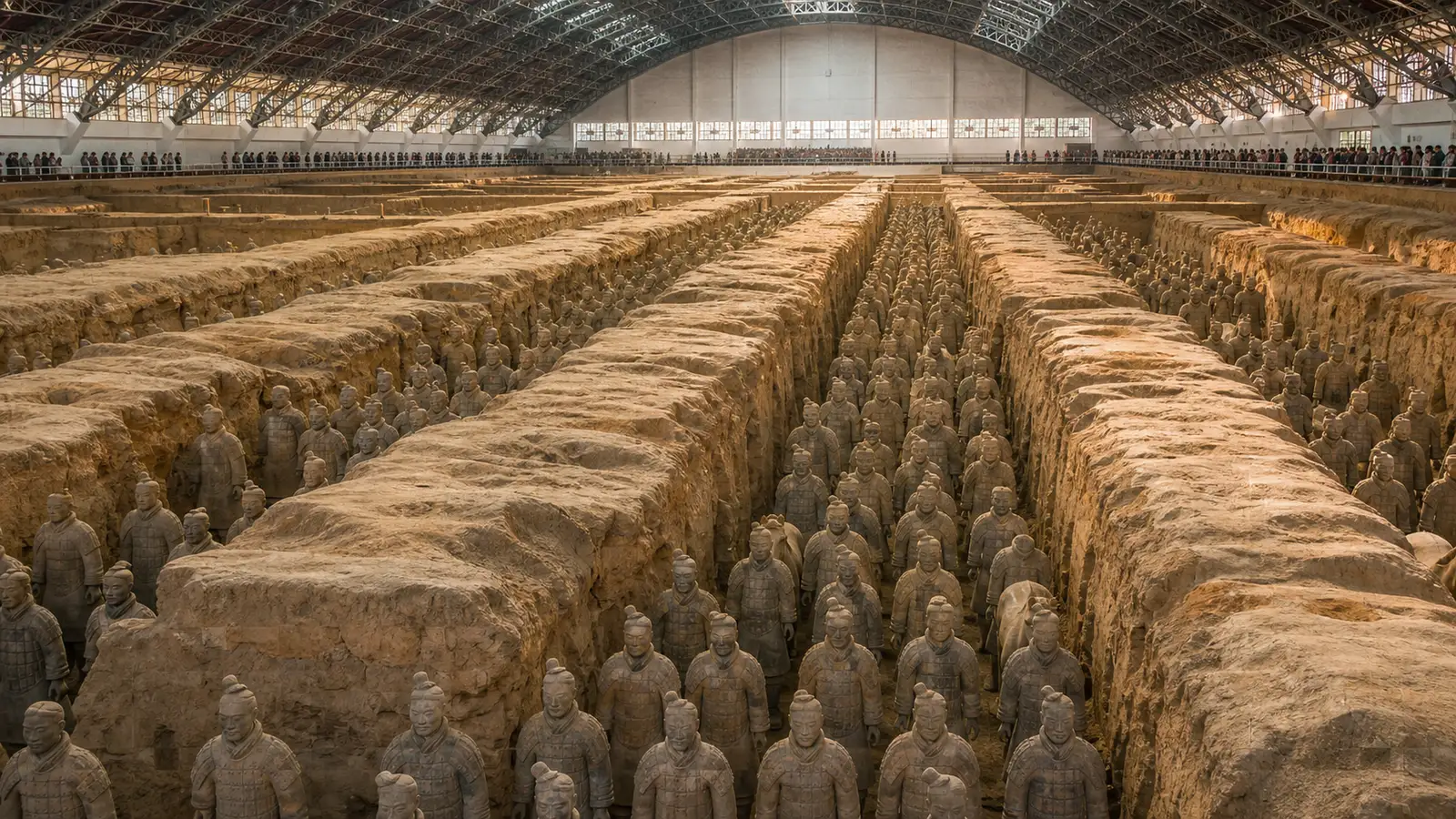
Xi'an was the start of the Silk Road and home to the famous Terracotta Army, giving first-timers a deep dose of ancient history. Its intact Ming-era city wall and lively Muslim Quarter make the old capital easy and rewarding to explore on foot.

Shanghai
Shanghai is China's most international and easiest-to-navigate big city, a good landing or finishing point for first-time travelers. The historic Bund waterfront facing a futuristic skyline shows the country's old and new sides side by side.

Chengdu
Chengdu is the place first-timers go to see giant pandas up close and to eat some of China's best-known spicy food. Its relaxed teahouse pace makes a welcome break from the bigger cities on a China itinerary.

Guilin
Guilin and the surrounding countryside offer the dramatic karst mountains and river scenery that appear on Chinese postcards and banknotes. It is where first-timers come for nature and slow river cruising after the urban sights elsewhere.
Frequently asked questions
- How many days do I need for a first trip to China?
- For a first visit covering the headline sights, plan 10 to 14 days. Ten days comfortably links Beijing, Xian, and Shanghai by high-speed rail and flights, while two weeks lets you add Chengdu for the pandas or Guilin for the Li River. Trying to see more than four cities in 10 days means most of your time is spent in transit rather than at the sights.
- Do US, UK, Canadian, and Australian visitors need a visa for China in 2026?
- For a full multi-city holiday you normally still need a tourist visa, but China's 240-hour (10-day) visa-free transit policy covers citizens of 55 countries including the US, UK, Canada, and Australia as of 2026. To use it you must arrive at one of the eligible ports, hold a confirmed onward ticket to a third country or region, and stay within the designated provinces. Confirm your eligibility with the National Immigration Administration before relying on it.
- When is the best time to visit China?
- Spring (April to May) and autumn (September to October) bring the mildest weather and clearest skies across Beijing, Xian, and Shanghai. Avoid the first week of October and the Lunar New Year period, when domestic travel peaks and trains, hotels, and major sights sell out fast. Summer is hot and humid with crowds at every attraction, while winter is cold in the north but quiet and cheaper.
- What is the best way to travel between Chinese cities?
- High-speed trains are the fastest and most comfortable option for the core route, covering Beijing to Xian in about 4.5 to 6 hours and Beijing to Shanghai in roughly 4.5 hours. Book through the official 12306 system or a trusted reseller, and bring the passport you booked with for station entry. For longer hops like Chengdu to Guilin, a domestic flight usually saves time.
- How much does a 2-week or 10-day China trip cost?
- Budget roughly USD 70 to 130 per day per person for a comfortable mid-range trip in 2026, covering a private hotel room, meals, local transport, and attraction tickets. On top of that, add the big intercity legs: a high-speed train such as Beijing to Xian runs about USD 75, Xian to Shanghai about USD 95, and a flight on the southern legs around USD 70 to 80. Backpackers staying in hostels and eating at street stalls can get by on USD 40 to 60 a day, while Beijing and Shanghai sit at the higher end of every range.
- What is the best itinerary for a first trip to China?
- The most reliable first-timer route is Beijing, Xian, and Shanghai, linked by high-speed rail and one short flight or train, over 10 to 12 days. Beijing covers the Forbidden City and Great Wall, Xian adds the Terracotta Army, and Shanghai gives you the modern, easy-to-navigate finale. Add Chengdu for pandas or Guilin for the Li River only if you have a full two weeks.
- How many cities should I try to see on my first China trip?
- Stick to three or at most four cities on a first visit. China is the size of the United States, so trying to cram in five or six destinations means you spend your days in stations and airports instead of at the sights. Three cities over 10 days gives you two to three full days in each, which is the right pace for first-timers.