Does Google Maps Work in China?
Google Maps is blocked in mainland China and its map data is offset and outdated even with a VPN. Here is what actually happens, why, and the map apps first-time visitors should use instead in 2026.
Last updated
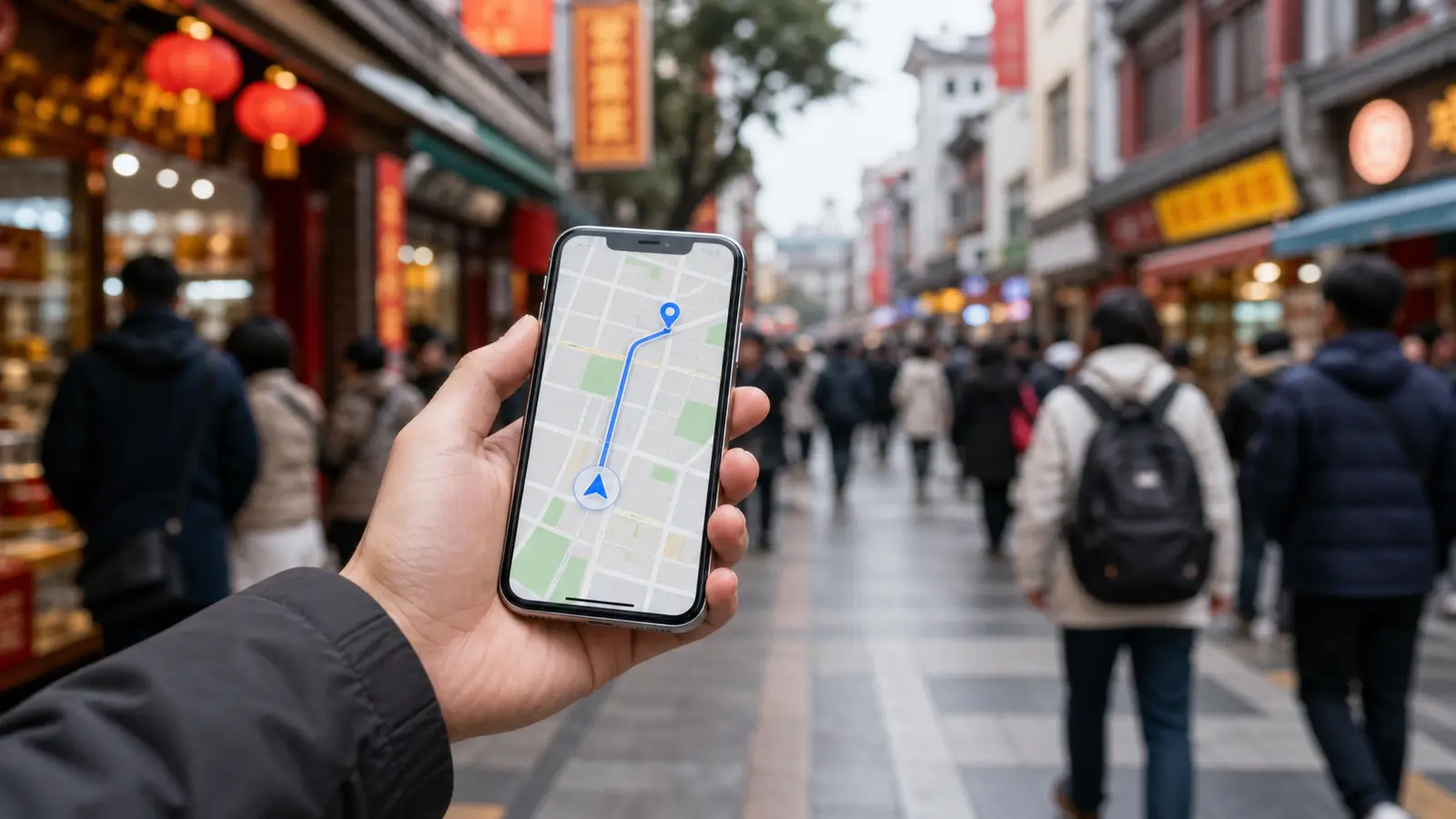
Quick rule: iPhone, use Apple Maps. It already runs on China-native data in English with nothing to install. Android, install Amap and switch it to English. Skip Google Maps: it is blocked, and even on a VPN its map is offset by 50 to 500 meters.
Short answer: not really. Google Maps is blocked behind China’s Great Firewall, so on a normal Chinese SIM or hotel Wi-Fi it will not load at all. Even when you force it open, the map you get is wrong in a way no setting can fix. For a first-time visitor, Google Maps is the one familiar tool that lets you down here, so plan to use something else.
Why it fails, even with a VPN
There are two separate problems, and people often only solve the first one.
The first is the network block. A VPN or a roaming eSIM can get past it and make Google Maps open. That part is fixable. For the practical choice before a trip, see China eSIM vs VPN.
The second problem is not. China legally requires all maps to use a scrambled coordinate system (nicknamed GCJ-02 or “Mars Coordinates”), and foreign map providers are not licensed to access current, corrected local data. The result is that Google’s map tiles and your blue GPS dot do not line up. Your location can show up anywhere from 50 to 500 meters away from where you are actually standing. Street layouts are dated, business listings are thin, and live public transport routing is mostly broken. So even on a VPN, Google Maps will happily walk you to the wrong side of the river. The block is a connection issue; the offset is a data issue, and a VPN only solves the first.
What to use instead
You have good, free, English options. Pick based on your phone.
- iPhone: Apple Maps. In mainland China, Apple licenses its map data from Autonavi, the company behind Amap, so you get the same accurate local data locals use, in a clean English interface, with the coordinate offset handled automatically. Nothing to install, nothing to configure. It is the single biggest reason an iPhone is easier than Android for navigating China.
- Android (or anyone who wants the best China-native app): Amap (Gaode Maps). Amap launched a full English version in January 2025 built for international users. It works in guest mode with no Chinese phone number, gives accurate metro directions down to the exact station exit, and shows live traffic and ride-hailing. Download it before you fly and switch the language to English in settings. Amap is also the maps engine inside our wider China travel apps setup.
- Offline backup: an offline map app such as Organic Maps, or MetroMan for subway routing, for moments when you are underground or out of signal. Save your hotel and key stops in advance.
A note on Baidu Maps: it is accurate but almost entirely in Chinese, so we do not recommend it for English speakers.
Does it matter which city you are in?
No, the same rules apply nationwide, because the coordinate offset and the Great Firewall block are countrywide. In a dense city like Beijing, where you will hop between metro lines, hutongs, and major sights, accurate metro routing matters most, and that is exactly where Apple Maps and Amap shine and Google Maps falls apart. Save your hotel, your subway stops, and each attraction in your chosen app before you leave Wi-Fi.
The practical bottom line
Do not rely on Google Maps in China. iPhone users should use Apple Maps; everyone else should use Amap in English. If you still want Google Translate, Gmail, or other blocked Google services on the trip, the cleanest fix is a travel eSIM that routes you over a foreign network so those apps simply work without fiddling with a VPN. See our guide to the best eSIM for China to set that up before you land, and round out your phone with the rest of the China travel apps first-time visitors actually need.
Frequently asked questions
- Do I need a VPN if I use a travel eSIM in China?
- Usually no. Most travel eSIMs route your data through international roaming, so Google, WhatsApp, Instagram and Gmail work normally without a VPN. A local Chinese SIM does not do this. The catch is that this only applies on the eSIM's mobile data; the moment you switch to local hotel or cafe Wi-Fi, the Great Firewall restrictions return.
- How much eSIM data do I need for a China trip?
- For a one to two week trip with daily maps, messaging, and photo uploads, plan on roughly 1 to 2 GB per day, so a 15 to 20 GB plan suits most first-time visitors. If you stream video or hotspot a laptop, choose an unlimited or high-cap plan such as those from Holafly or Airalo. Many travelers download offline maps in advance to stretch their data further.
- Does Google Maps work in China?
- Google Maps is blocked on local Chinese Wi-Fi, but it works if you are connected through a travel eSIM that routes data outside the mainland. Its location accuracy is also offset inside China, so pins can sit a street or two away from the real spot. For reliable navigation, many visitors download offline Google Maps before arriving or use Apple Maps, which performs better on the mainland.
- What is the best navigation app to use in China?
- For walking and metro directions, Apple Maps and offline Google Maps are the easiest for English speakers. For taxis, public transport, and accurate door-to-door routing, the local app Amap (Gaode) has an English mode and is far more precise than Google inside China. Save your hotel address in Chinese characters so you can show it to drivers or paste it into the app.